1. What Is a Priority Queue?
Among the various data structures Java provides, let's look at the Priority Queue. Like the Queue data structure we know well, it operates with the FIFO (First-In-First-Out) algorithm, but additionally you can think of it as operating with the BIFO (Best-In-First-Out) algorithm that has priority. In terms of basic data structures, it's easy to understand it as a Heap (Min, Max) data structure.
The PriorityQueue class is an implementation that implements the Queue interface, and now let's look at how to use it through examples.
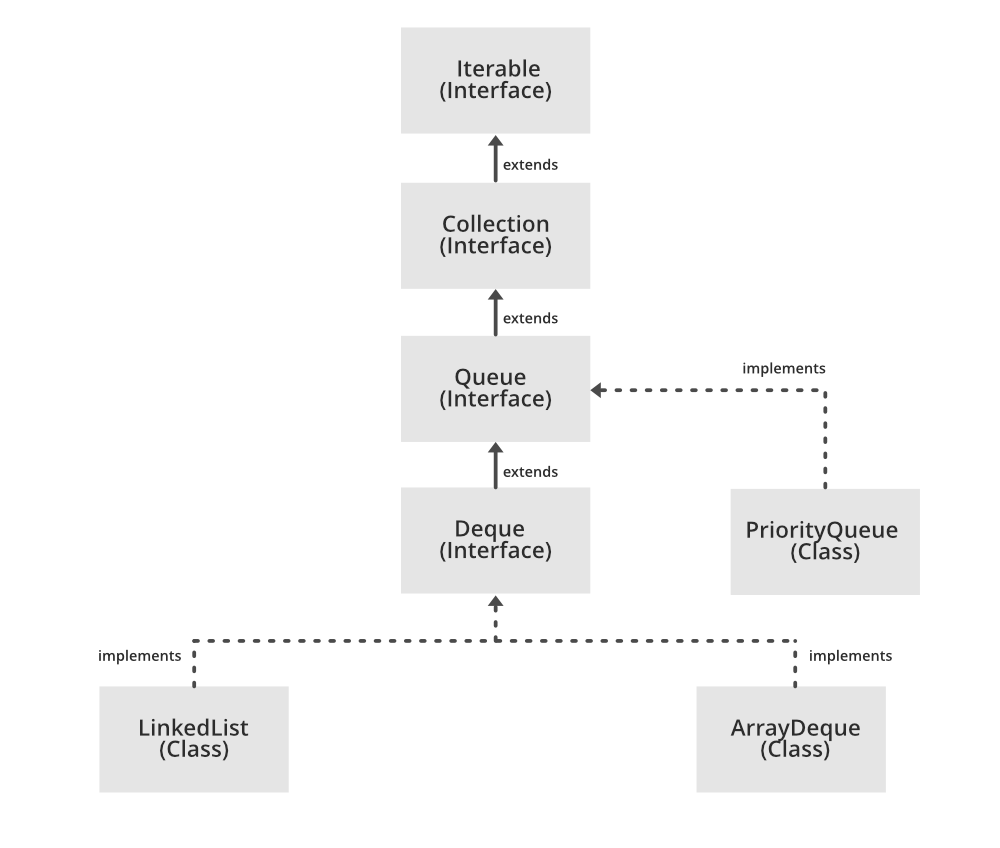
The class diagram is excerpted from GeeksforGeeks
1.1 Basic Methods and Complexity
This is an explanation of the basic methods provided by the PriorityQueue class and their complexity.
| Method name | Complexity | Description |
|---|---|---|
boolean add(E element) | O(N log N) | Inserts into the queue according to priority. |
public peek() | O(1) | Lets you check the first item of the queue without removing it |
public poll() | O(1) | Removes the first item of the queue and returns the data |
For more details on the methods, please refer to the Oracle Java API.
2. How to Use a Priority Queue
3. Min Heap
If you create a PriorityQueue object with no additional arguments, it operates as a Min Heap. As you can see in the example, when you extract data after adding it, the lowest value is returned.
 @Test
 public void test_minHeap() {
        PriorityQueue<Integer> minHeap = new PriorityQueue<>();
        minHeap.add(3);
        minHeap.add(1);
        minHeap.add(10);
        minHeap.add(5);

        assertThat(minHeap.poll()).isEqualTo(1);
        assertThat(minHeap.poll()).isEqualTo(3);
}
3.1 Max Heap
When creating a PriorityQueue object, you can specify the priority for the data by passing a Comparator to the constructor. To make the Max value of Integer be returned when extracting values, specify it with the reverseOrder() method provided by default in Collections.
 @Test
 public void test_maxHeap() {
        PriorityQueue<Integer> minHeap = new PriorityQueue<>(Collections.reverseOrder());
        minHeap.add(3);
        minHeap.add(1);
        minHeap.add(10);
        minHeap.add(5);

        assertThat(minHeap.poll()).isEqualTo(10);
        assertThat(minHeap.poll()).isEqualTo(5);
}
3.2 Min Heap - Student Object
Besides basic Integer values, you can also set a specific value in an object to have priority. In the example, it is set so that the lowest Age value of the Student object is extracted first. To pass a Comparator as an argument, the Comparator.comparing() method was used. The comparing() method returns a Comparator method function based on the field value passed as an argument, making it easy to create a Comparator.
@Test
public void test_student_age() {
        int capacity = 4;
        PriorityQueue<Student> studentAgeHeap = new PriorityQueue<>(capacity, Comparator.comparing((Student student) -> student.getAge()));

        studentAgeHeap.add(new Student("Frank", 23));
        studentAgeHeap.add(new Student("Angela", 10));
        studentAgeHeap.add(new Student("David", 30));
        studentAgeHeap.add(new Student("Joe", 15));

        assertThat(studentAgeHeap.poll().getName()).isEqualTo("Angela");
        assertThat(studentAgeHeap.poll().getName()).isEqualTo("Joe");

}
4. Wrapping Up
PriorityQueue is a Queue data structure that has priority. If you use PriorityQueue during development, you can easily use it as a Min+Max Heap data structure.
For the example code, please refer to github.
5. References
- Priority Queue
- http://asuraiv.blogspot.com/2015/11/java-priorityqueue.html
- https://coding-factory.tistory.com/603
- https://woovictory.github.io/2020/05/13/PriorityQueue/
- https://lottogame.tistory.com/996
- https://www.webucator.com/how-to/how-use-the-comparatorcomparing-method-java-8.cfm
- https://medium.com/@logishudson0218/java-collection-framework-896a6496b14a
- Heap
- Comparator.comparing