1. Types of Keys in a Database
In this post, let's summarize the various types of keys in a database.

To explain the types of keys, let's use the sample data below. The sample data was obtained from the dummy data site, which generates it automatically.
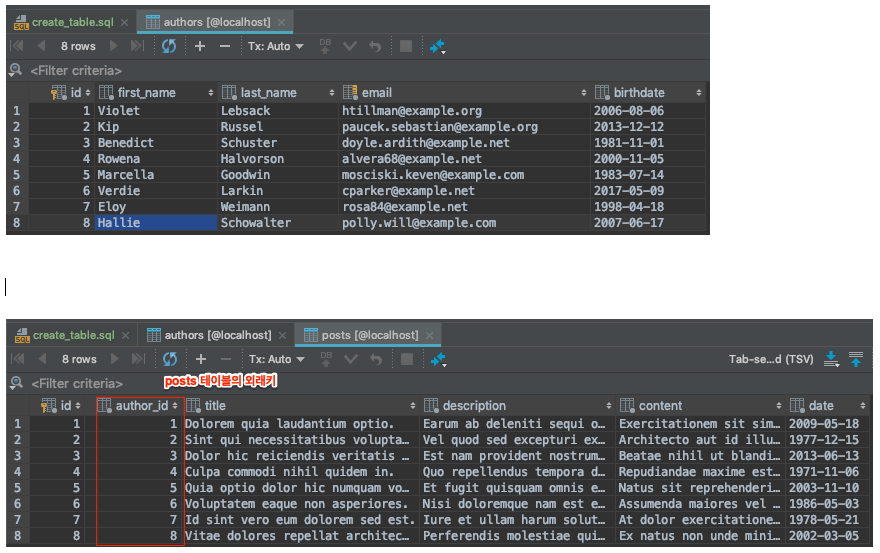
1.1 Super Key
- A key consisting of a set of attributes that satisfy the uniqueness property is called a super key
- What is uniqueness? - It means the property of being able to identify any row directly with a single key
- e.g. the authors table
- id, (id, first_name), (first_name, last_name), email, etc. become super keys
1.2 Candidate Key
- An attribute or set of attributes that satisfies both uniqueness and minimality. In other words, among super keys, the ones that satisfy minimality become candidate keys
- What is minimality? - It consists only of the attributes strictly necessary to identify a record
- e.g. the authors table
- id and email become candidate keys
1.3 Primary Key
- A key specially chosen among the candidate keys
- A primary key cannot have NULL values or duplicate values
- e.g. the authors table * Among the candidate keys, id can be selected as the primary key. (no duplicate values or NULL values)
1.4 Alternate Key
- An alternate key refers to a candidate key that was not chosen as the primary key, and is also called a secondary key
- e.g. the authors table
- email becomes the alternate key.
1.5 Foreign Key
- It refers to a key where an attribute in one relation becomes the primary key of another relation
- The domain of the foreign key attribute and the domain of the referenced primary key attribute must be the same
- A foreign key may reference the same relation
- A foreign key may have NULL values
- e.g. the posts table
- authors_id becomes the foreign key