When working with multiple goroutines in Go, there are questions you naturally run into. "When should I stop this goroutine?", "What if the request doesn't finish within 3 seconds?", "How do I pass the request ID down to lower-level functions?" The answer to all these questions is the context package.
1. Introduction - Why the context Package Is Needed
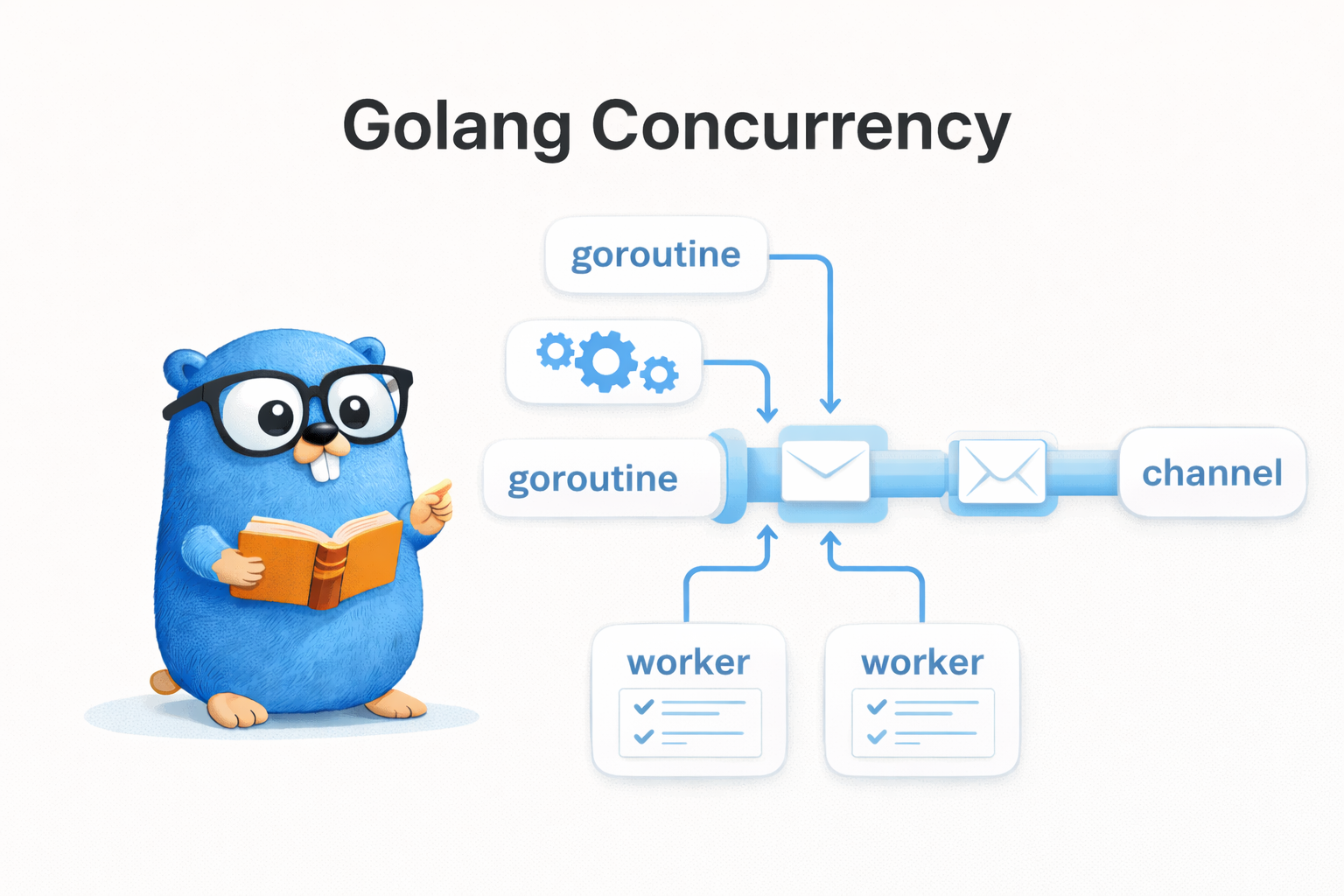
When a server handles an HTTP request, it's common for a single request to be distributed across multiple goroutines. Three core requirements arise here.
- goroutine cancellation: when the client disconnects, all related goroutines must be cleaned up
- timeout management: you need to put a time limit on external API calls or DB queries
- passing request-scoped values: request ID, authentication info, etc. need to be passed along the function chain
The context package unifies these three into a single interface.
type Context interface {
    Deadline() (deadline time.Time, ok bool)
    Done() <-chan struct{}
    Err() error
    Value(key any) any
}
Done(): returns a channel that closes when the context is canceled or expiresErr(): returns the reason the Done channel closed (CanceledorDeadlineExceeded)Deadline(): returns the expiration timeValue(): looks up a value stored in the context
2. context.Background() and context.TODO()
There are two empty contexts that serve as the root of every context tree.
ctx := context.Background() // the general root context
ctx := context.TODO()       // when you don't yet know which context to use
context.Background(): used as the top-level context in the main function, initialization code, and testscontext.TODO(): used temporarily when you haven't yet decided which context to pass. When you see a TODO in code review, it's a signal that "the context design here needs to be checked"
In practice, you mostly use context.Background() as the root and wrap it with WithCancel, WithTimeout, WithValue, etc. to create derived contexts.
3. WithCancel - Cancellation Propagation
3.1 Basic Usage
context.WithCancel returns a new context and a cancel function from a parent context. Calling cancel() closes the Done() channel and terminates the goroutine watching it.
func TestWithCancel(t *testing.T) {
    ctx, cancel := context.WithCancel(context.Background())

    var stopped atomic.Bool

    go func() {
        <-ctx.Done() // wait until cancel() is called
        stopped.Store(true)
    }()

    cancel() // cancel explicitly
    time.Sleep(50 * time.Millisecond)

    assert.True(t, stopped.Load())
    assert.ErrorIs(t, ctx.Err(), context.Canceled)
}
When cancel() is called, ctx.Done() closes and the goroutine wakes up. ctx.Err() returns context.Canceled.
If you're curious about the internal implementation of the
cancel()function, see FAQ - cancel() internal implementation.
3.2 Cancellation Chain (parent -> child)
A context forms a tree structure. When a parent is canceled, all children are automatically canceled. Conversely, canceling a child does not affect the parent.
func TestCancelChain(t *testing.T) {
    parent, parentCancel := context.WithCancel(context.Background())
    child, childCancel := context.WithCancel(parent)
    defer childCancel()

    parentCancel() // cancel parent → child is canceled too
    time.Sleep(50 * time.Millisecond)

    assert.ErrorIs(t, parent.Err(), context.Canceled)
    assert.ErrorIs(t, child.Err(), context.Canceled)
}
Even though only parentCancel() was called, child.Err() also becomes context.Canceled. This is the essence of context propagation.
3.3 Use in the worker Pattern
This is the most commonly used pattern in practice. A worker goroutine watches ctx.Done() with select and terminates cleanly when a cancellation signal arrives.
func TestCancelWorker(t *testing.T) {
    ctx, cancel := context.WithCancel(context.Background())
    results := make(chan int, 10)

    // worker: works until canceled
    go func() {
        defer close(results)
        for i := 0; ; i++ {
            select {
            case <-ctx.Done():
                return
            case results <- i:
                time.Sleep(10 * time.Millisecond)
            }
        }
    }()

    // cancel after 50ms
    time.Sleep(50 * time.Millisecond)
    cancel()

    var collected []int
    for v := range results {
        collected = append(collected, v)
    }

    t.Logf("collected values: %v", collected)
    assert.Greater(t, len(collected), 0)
}
The worker loops infinitely sending results to a channel, and when ctx.Done() closes, it exits via return. Since defer close(results) cleans up the channel too, range results terminates naturally.
4. WithTimeout and WithDeadline
4.1 The Difference Between timeout and deadline
Both cancel the context based on time, but the way they specify the time differs.
WithTimeout(parent, duration): cancel after duration from nowWithDeadline(parent, time): cancel at a specific time
Internally, WithTimeout calls WithDeadline(parent, time.Now().Add(timeout)). Ultimately it's the same mechanism.
func TestWithTimeout(t *testing.T) {
    ctx, cancel := context.WithTimeout(context.Background(), 50*time.Millisecond)
    defer cancel()

    select {
    case <-time.After(200 * time.Millisecond):
        t.Fatal("should have timed out")
    case <-ctx.Done():
        assert.ErrorIs(t, ctx.Err(), context.DeadlineExceeded)
    }
}
Since a 50ms timeout was set, ctx.Done() closes before the 200ms wait completes. When canceled by timeout, ctx.Err() returns context.DeadlineExceeded.
func TestWithDeadline(t *testing.T) {
    deadline := time.Now().Add(50 * time.Millisecond)
    ctx, cancel := context.WithDeadline(context.Background(), deadline)
    defer cancel()

    <-ctx.Done()
    assert.ErrorIs(t, ctx.Err(), context.DeadlineExceeded)

    // check the expiration time with the Deadline() method
    dl, ok := ctx.Deadline()
    assert.True(t, ok)
    assert.Equal(t, deadline, dl)
}
WithDeadline uses an absolute time. You can look up the set expiration time with the Deadline() method.
4.2 Nested Timeout (when the inner one is shorter)
When nesting timeouts, the shorter timeout always takes precedence. Even if the inner context expires first, the outer context is unaffected.
func TestNestedTimeout(t *testing.T) {
    outer, outerCancel := context.WithTimeout(context.Background(), 200*time.Millisecond)
    defer outerCancel()

    inner, innerCancel := context.WithTimeout(outer, 50*time.Millisecond)
    defer innerCancel()

    <-inner.Done()

    // inner times out first
    assert.ErrorIs(t, inner.Err(), context.DeadlineExceeded)
    // outer is still alive
    assert.NoError(t, outer.Err())
}
outer is 200ms, inner is 50ms. inner expires first, but outer is still valid. This pattern is like putting a shorter timeout on a DB query (inner) inside an HTTP handler (outer).
What if the inner's timeout is longer than the outer's? In that case too, if outer is canceled first, inner is canceled along with it. A parent's cancellation always propagates to its children.
5. WithValue - Passing Request-Scoped Values
5.1 Basic Usage
context.WithValue stores a key-value pair in the context. It's mainly used to pass request-scoped data such as request IDs, authentication tokens, and tracing information.
func TestWithValue(t *testing.T) {
    ctx := context.Background()
    ctx = context.WithValue(ctx, userIDKey, "user-123")
    ctx = context.WithValue(ctx, requestIDKey, "req-456")

    // look up values
    userID := ctx.Value(userIDKey).(string)
    requestID := ctx.Value(requestIDKey).(string)

    assert.Equal(t, "user-123", userID)
    assert.Equal(t, "req-456", requestID)
}
Looking up a non-existent key returns nil. So it's safe to do a nil check before a type assertion.
5.2 Preventing Collisions with a typed key
If you use string directly as a context key, different packages might use the same string as a key, causing a collision. Defining a private type as the key prevents this problem.
// define type-safe context keys
type contextKey string

const (
    userIDKey    contextKey = "userID"
    requestIDKey contextKey = "requestID"
)
contextKey is based on string but is a distinct type, so even if another package accesses it as string("userID"), the types differ and won't match. This is the standard pattern for preventing context key collisions in Go.
5.3 value chain (looking up parent -> child values)
A context value is searched toward the parent along the tree. When you look up a value in a child context, if it's not on the child, it checks the parent, and if not on the parent, its parent, in order.
func TestWithValueChain(t *testing.T) {
    parent := context.WithValue(context.Background(), userIDKey, "parent-user")
    child := context.WithValue(parent, requestIDKey, "child-req")

    // can access the parent's value from the child
    assert.Equal(t, "parent-user", child.Value(userIDKey))
    assert.Equal(t, "child-req", child.Value(requestIDKey))

    // cannot access the child's value from the parent
    assert.Nil(t, parent.Value(requestIDKey))
}
The child can access the parent's userIDKey value, but the parent cannot access the child's requestIDKey value. Value lookup always proceeds from bottom to top (from child toward parent).
6. Context Propagation Patterns
6.1 parent cancellation -> all children canceled
If you create multiple child goroutines from a single root context, you can clean up all goroutines at once just by canceling the root.
func TestPropagation(t *testing.T) {
    root, rootCancel := context.WithCancel(context.Background())

    var stopped atomic.Int64

    // create 3 child goroutines
    for i := range 3 {
        child, childCancel := context.WithCancel(root)
        defer childCancel()

        go func() {
            <-child.Done()
            stopped.Add(1)
            t.Logf("child %d stopped", i)
        }()
    }

    rootCancel() // cancel root → all children canceled
    time.Sleep(50 * time.Millisecond)

    assert.Equal(t, int64(3), stopped.Load())
}
A single rootCancel() cleans up all 3 child goroutines. This is the power of context propagation. In an HTTP server, when a client disconnects, you can clean up all goroutines derived from that request with this pattern.
6.2 Pass context as the function's first parameter (Go convention)
There's a convention established in the Go community. Pass context as the function's first parameter, and use ctx as the variable name.
// worker - a function that takes context as the first parameter (Go convention)
func worker(ctx context.Context, id int, results chan<- string) {
    for {
        select {
        case <-ctx.Done():
            results <- fmt.Sprintf("worker %d: stopped", id)
            return
        case <-time.After(10 * time.Millisecond):
            results <- fmt.Sprintf("worker %d: working", id)
        }
    }
}
Using this worker function with a WaitGroup enables clean goroutine management.
func TestContextAsFirstParam(t *testing.T) {
    ctx, cancel := context.WithTimeout(context.Background(), 50*time.Millisecond)
    defer cancel()

    results := make(chan string, 100)

    var wg sync.WaitGroup
    wg.Add(2)
    go func() { defer wg.Done(); worker(ctx, 1, results) }()
    go func() { defer wg.Done(); worker(ctx, 2, results) }()

    // close the channel after all workers terminate
    go func() {
        wg.Wait()
        close(results)
    }()

    var messages []string
    for msg := range results {
        messages = append(messages, msg)
    }

    t.Logf("messages: %v", messages)
    assert.Greater(t, len(messages), 0)
}
It sets a 50ms limit with WithTimeout, waits for all workers to terminate with a WaitGroup, and then closes the channel. Combining context and WaitGroup lets you safely manage "parallel work with a time limit."
7. Best Practices
7.1 Don't Abuse context.Value
context.Value is convenient, but it should not be used to replace function signatures.
// bad example: putting function parameters into context
ctx = context.WithValue(ctx, "dbConn", db)
ctx = context.WithValue(ctx, "logger", log)

// good example: use explicit parameters
func HandleRequest(ctx context.Context, db *sql.DB, log *slog.Logger) {
    // ...
}
Data suitable for context.Value is request-scoped and hard to put in a function signature. Typical examples are request IDs, tracing spans, and authentication tokens.
7.2 Don't Store context in a struct
// bad example
type Server struct {
    ctx context.Context // don't store in a struct
}

// good example: pass as a method parameter
func (s *Server) HandleRequest(ctx context.Context) {
    // ...
}
A context should exist together with the request's lifecycle. Storing it in a struct makes it ambiguous which request's context it is, and cancellation propagation may not work properly.
7.3 Always Call cancel() with defer
The cancel function returned by WithCancel, WithTimeout, and WithDeadline must be called. If you don't call it, context-related resources won't be released, causing a memory leak.
ctx, cancel := context.WithTimeout(context.Background(), 5*time.Second)
defer cancel() // always call with defer

// do work...
Even when the timeout expires and it's automatically canceled, it's safe to call cancel(). Calling cancel() on an already-canceled context does nothing (idempotent).
8. Wrapping Up
| Function | Use | When Done closes | Err return value |
|---|---|---|---|
WithCancel | explicit cancellation | when cancel() is called | context.Canceled |
WithTimeout | time limit (relative) | after duration elapses | context.DeadlineExceeded |
WithDeadline | time limit (absolute) | when the deadline is reached | context.DeadlineExceeded |
WithValue | passing values | (no cancellation feature) | - |
The core principles of the context package can be summarized as follows.
- pass context as the function's first parameter
- call cancel() immediately with defer
- a parent's cancellation propagates to all children
- context.Value stores only request-scoped data
- pass context as a parameter, not in a struct
context is the core tool for managing the goroutine lifecycle in Go. It's especially essential in server programming when implementing request handling, timeout management, and graceful shutdown.
9. FAQ
9.1 Q. How is the cancel() function implemented internally?
The cancel() function returned by context.WithCancel is defined on the cancelCtx struct in the Go standard library (go/src/context/context.go).
// cancelCtx - the internal struct of a cancelable context
type cancelCtx struct {
    Context                        // embeds the parent context
    mu       sync.Mutex            // mutex to protect concurrent access
    done     atomic.Value          // stores chan struct{}, lazily created on first call
    children map[canceler]struct{} // list of child contexts (for cancellation propagation)
    err      error                 // cancellation reason (Canceled or DeadlineExceeded)
    cause    error                 // Go 1.20+ cause chain
}

// cancel - the actual cancellation logic
func (c *cancelCtx) cancel(removeFromParent bool, err, cause error) {
    c.mu.Lock()

    if c.err != nil {
        c.mu.Unlock()
        return // ignore if already canceled (guarantees idempotency)
    }

    c.err = err     // set context.Canceled
    c.cause = cause

    // close the done channel to wake goroutines waiting on <-ctx.Done()
    d, _ := c.done.Load().(chan struct{})
    if d == nil {
        c.done.Store(closedchan) // if not yet created, store a pre-closed channel
    } else {
        close(d) // close the existing channel → all receivers wake up immediately
    }

    // recursively cancel all child contexts too
    for child := range c.children {
        child.cancel(false, err, cause)
    }
    c.children = nil
    c.mu.Unlock()

    if removeFromParent {
        removeChild(c.Context, c) // remove itself from the parent's children map
    }
}
The core behavior can be summarized as follows.
| Step | Behavior | Description |
|---|---|---|
| 1 | idempotency check | safe to call cancel() multiple times (only the first runs) |
| 2 | set err | set it so ctx.Err() returns context.Canceled |
| 3 | close the done channel | close(d) wakes all goroutines waiting on <-ctx.Done() |
| 4 | propagate cancellation to children | iterate the children map and recursively cancel all children |
| 5 | remove from parent | remove itself from the parent's children map to free memory |
close(d) is the key — in Go, a closed channel immediately returns the zero value, so all goroutines waiting on <-ctx.Done() wake up simultaneously. This is why context's cancellation propagation is efficient.
9.2 Q. How should I set the context timeout when calling a DB / external API from an API handler?
When an API handler calls a DB query or an external API, if a problem occurs at any layer, the entire request can stall. To prevent this, you need to set context timeouts appropriately.
Method 1: a single timeout for the entire request
// resty client (reused at the package level)
var client = resty.New()

func handler(w http.ResponseWriter, r *http.Request) {
    ctx, cancel := context.WithTimeout(r.Context(), 5*time.Second) // 5-second limit for the whole thing
    defer cancel()

    // DB query — interrupted when ctx is canceled
    user, err := db.GetUser(ctx, userID)
    if err != nil { return }

    // external API call — pass the same ctx to resty
    var profile Profile
    _, err = client.R().
        SetContext(ctx).           // propagate the context
        SetResult(&profile).
        Get(fmt.Sprintf("https://api.example.com/profile/%s", user.Email))
    if err != nil { return }
}
It's simple, but it has the problem that if the DB takes 4.5 seconds, the external API has only 0.5 seconds.
Method 2: per-layer individual timeouts (recommended)
func handler(w http.ResponseWriter, r *http.Request) {
    ctx := r.Context() // the parent context

    // 2-second limit for the DB
    dbCtx, dbCancel := context.WithTimeout(ctx, 2*time.Second)
    defer dbCancel()
    user, err := db.GetUser(dbCtx, userID)
    if err != nil { return }

    // 3-second limit for the external API — pass an individual context to resty
    apiCtx, apiCancel := context.WithTimeout(ctx, 3*time.Second)
    defer apiCancel()

    var profile Profile
    _, err = client.R().
        SetContext(apiCtx).        // per-layer timeout context
        SetResult(&profile).
        Get(fmt.Sprintf("https://api.example.com/profile/%s", user.Email))
    if err != nil { return }
}
By giving each layer an appropriate timeout, a slowdown in one doesn't affect the other layers. resty's SetContext() internally calls http.Request.WithContext(), so when a timeout or cancel occurs, even the TCP connection is interrupted immediately.
Method 3: parallel calls + errgroup (when the calls are independent)
If the DB and external API are independent of each other, you can call them in parallel and cancel the rest if any one fails.
func handler(w http.ResponseWriter, r *http.Request) {
    ctx, cancel := context.WithTimeout(r.Context(), 5*time.Second)
    defer cancel()

    g, gCtx := errgroup.WithContext(ctx) // any error → the rest are automatically canceled

    var user *User
    var profile Profile

    g.Go(func() error {
        var err error
        user, err = db.GetUser(gCtx, userID) // use gCtx
        return err
    })

    g.Go(func() error {
        _, err := client.R().
            SetContext(gCtx).      // errgroup's context → auto-canceled when another goroutine fails
            SetResult(&profile).
            Get(fmt.Sprintf("https://api.example.com/profile/%s", email))
        return err
    })

    if err := g.Wait(); err != nil { return }
}
| Pattern | When to use |
|---|---|
| whole-request timeout | simple APIs, when there are 1-2 layers |
| per-layer timeout | when the DB/external API have different allowed times (most recommended) |
| errgroup + context | parallel independent calls, cancel the rest if one fails |
How resty's
SetContext()works internally: when you callSetContext(ctx), resty internally uses the Go standard library'shttp.Request.WithContext(ctx). This context propagates down to theroundTrip()step ofnet/http.Transport, so when the context is canceled, it's immediately interrupted at every step of the HTTP request — DNS lookup, TCP connection, TLS handshake, response reading. Therefore, as long as you passSetContext(ctx)correctly, unnecessary network resources are immediately released on timeout or cancel.// inside resty (simplified) func (r *Request) Execute(method, url string) (*Response, error) { // 1. create an http.Request req, _ := http.NewRequestWithContext(r.ctx, method, url, body) // 2. call http.Client.Do() — immediately interrupted when the context is canceled resp, err := r.client.httpClient.Do(req) // returns a context.DeadlineExceeded or context.Canceled error }
9.3 Q. How do I manage timeouts in the Echo framework?
Echo has a built-in TimeoutMiddleware, so you can automatically apply a timeout to all handlers.
import "github.com/labstack/echo/v4/middleware"

e := echo.New()

// apply a 5-second timeout to all handlers
e.Use(middleware.TimeoutWithConfig(middleware.TimeoutConfig{
    Timeout: 5 * time.Second,
}))
In a handler, use the timeout context set by the middleware via c.Request().Context().
func getUser(c echo.Context) error {
    ctx := c.Request().Context() // the timeout context set by the middleware

    user, err := db.GetUser(ctx, id)
    if err != nil {
        if errors.Is(err, context.DeadlineExceeded) {
            return echo.NewHTTPError(http.StatusGatewayTimeout, "request timed out")
        }
        return err
    }
    return c.JSON(http.StatusOK, user)
}
You can also set a different timeout per route.
// default 5 seconds
e.Use(middleware.TimeoutWithConfig(middleware.TimeoutConfig{
    Timeout: 5 * time.Second,
}))

// 30 seconds only for the file upload route
uploadGroup := e.Group("/upload")
uploadGroup.Use(middleware.TimeoutWithConfig(middleware.TimeoutConfig{
    Timeout: 30 * time.Second,
}))
The middleware is the upper limit for the entire request, while per-layer granularity (DB 2 seconds, external API 3 seconds) is, as a practical pattern, set directly inside the handler with context.WithTimeout.