1. What Is HandlerMethodArgumentResolver?
1.1 Introduction
Let's look at HandlerMethodArgumentResolver. As shown below, we often work by adding various argument values (e.g. @PathVariable) to controller methods. Such arguments are handled by HandlerMethodArgumentHandler.
As needed, we add various argument values to controller methods, and these arguments are handled by HandlerMethodArgumentHandler.
@GetMapping
public ResponseEntity<?> getStudentList(
  @PathVariable(value = "version") Integer version,
  @RequestParam(value = "listSize", defaultValue = "10") Integer listSize) {
  ...omitted...
}
HandlerMethodArgumentHandler is responsible for passing the actual value to the controller according to the annotation or type. Spring also has several Argument Resolvers implemented by default.
PathVariableMethodArgumentResolver- an Argument Resolver that handles arguments declared with the
@PathVariableannotation
- an Argument Resolver that handles arguments declared with the
RequestParamMethodArgumentResolver- specifies the actual value of an argument declared with the
@RequestParamannotation
- specifies the actual value of an argument declared with the
- RequestHeaderMapMethodArgumentResolver
- specifies the actual value of an argument declared with the
@RequestHeaderannotation
- specifies the actual value of an argument declared with the
Using HandlerMethodArgumentHandler has the advantage of reducing duplicate code and extracting it as a common feature for reuse. Now let's implement a custom HandlerMethodArgumentResolver ourselves.
2. Creating a Custom Argument Resolver
2.1 Example of Using an Argument Resolver in a Controller
Let's create a Resolver that can obtain the client IP address when you pass an argument annotated with @ClientIp in a controller method.
@RestController
public class IpController {
    @GetMapping("/test")
    public String getIpAddress(@ClientIp String clientIp) {
        return String.format("ip address : %s", clientIp);
    }
}
2.2 Creating the Argument Resolver
The Argument Resolver interface has two methods, and resolveArgument() is executed when supportsParameter() is true.
public interface HandlerMethodArgumentResolver {

	boolean supportsParameter(MethodParameter parameter);

	@Nullable
	Object resolveArgument(MethodParameter parameter, @Nullable ModelAndViewContainer mavContainer,
			NativeWebRequest webRequest, @Nullable WebDataBinderFactory binderFactory) throws Exception;

}
| Method | Description |
|---|---|
supportsParameter | returns true/false for whether the resolver supports the current parameter |
resolveArgument | returns the actual object to bind |
@Slf4j
@Component
public class ClientIpArgumentResolver implements HandlerMethodArgumentResolver {
    @Override
    public boolean supportsParameter(MethodParameter methodParameter) {
        return methodParameter.hasParameterAnnotation(ClientIp.class);
    }

    @Override
    public Object resolveArgument(MethodParameter methodParameter, ModelAndViewContainer modelAndViewContainer, NativeWebRequest nativeWebRequest, WebDataBinderFactory webDataBinderFactory) throws Exception {
        HttpServletRequest request = (HttpServletRequest) nativeWebRequest.getNativeRequest();

        String clientIp = request.getHeader("X-Forwarded-For");
        if (StringUtils.isEmpty(clientIp) || "unknown".equalsIgnoreCase(clientIp)) {
            clientIp = request.getRemoteAddr();
        }
        log.debug("[debug] clientIp : {}", clientIp);
        return clientIp;
    }
}
- the
supportsParameter()method checks whether the argument value includes the ClientIp annotation - the
resolveArgument()method has the logic to obtain the actual client IP address from the request
2.3 Registering the Argument Resolver
Now you just need to add the Resolver you created earlier in the addArgumentResolvers() method.
@RequiredArgsConstructor
@Configuration
public class WebConfig implements WebMvcConfigurer {
    private final ClientIpArgumentResolver clientIpArgumentResolver;

    @Override
    public void addArgumentResolvers(List<HandlerMethodArgumentResolver> argumentResolvers) {
        argumentResolvers.add(clientIpArgumentResolver);
    }
}
2.4 Running the Controller
Let's verify it with a unit test. The controller is returning the client IP address correctly.
@Test
void getIpAddress() throws Exception {
  this.mockMvc.perform(get("/test"))
  .andDo(print())
  .andExpect(status().isOk())
  .andExpect(jsonPath("$", is("ip address : 127.0.0.1")));
}
3. How the Argument Resolver Works
We implemented a custom Argument Resolver. Now let's look at how the Argument Resolver is called internally within Spring. This is an image that clearly shows the Argument Resolver operating structure (referenced from Carrey's tech blog).

The broad order in which the Argument Resolver runs when processing a request is as follows. You can understand it more easily if you debug during actual execution.
- The client sends a request
- The request is handled by the Dispatcher Servlet
- HandlerMapping processing for the request
- (at Spring startup)
RequestMappingHandlerAdapterregisters the necessary Argument resolvers (#1.2.1) - (on request)
RequestMappingHandlerAdapter.invokeHandlerMethod()runs the Argument resolver (#1.2.2)DispatcherServlet.doDispatch()->RequestMappingHandlerAdapter.handleInternal()->invokeHandlerMethod()
- (at Spring startup)
- The controller method is executed
1.2.1 Where Are the Default Spring + Custom Argument Resolvers Registered?
When the RequestMappingHandlerAdapter object is initialized (e.g. at Spring startup), afterPropertiesSet() calls the getDefaultArgumentResolvers() method to register the default Spring resolvers and the custom resolver.
private List<HandlerMethodArgumentResolver> getDefaultArgumentResolvers() {
		List<HandlerMethodArgumentResolver> resolvers = new ArrayList<>(30);
		...omitted...

		resolvers.add(new PathVariableMethodArgumentResolver());
		resolvers.add(new RequestPartMethodArgumentResolver(getMessageConverters(), this.requestResponseBodyAdvice));
		resolvers.add(new RequestHeaderMethodArgumentResolver(getBeanFactory()));

    ...omitted...
		// Custom arguments
		if (getCustomArgumentResolvers() != null) {
			resolvers.addAll(getCustomArgumentResolvers());
		}
}
1.2.2 Where Is supportsParameter Called?
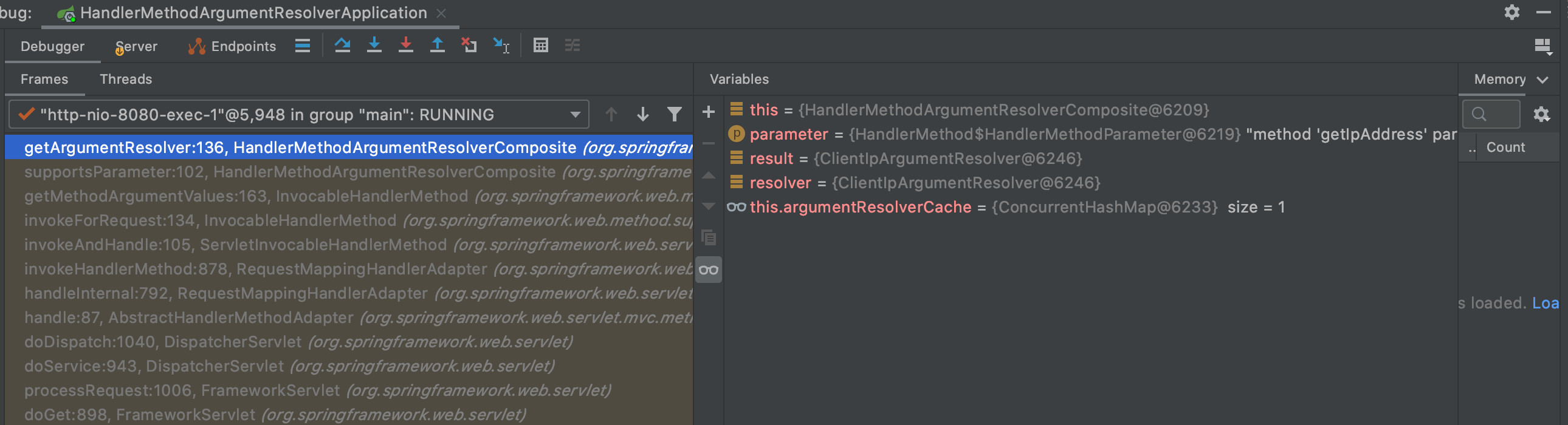
In the HandlerMethodArgumentResolverComposite.getArgumentResolver() method, supportsParameter() is executed, and if it returns true, the corresponding Argument Resolver is returned.
private HandlerMethodArgumentResolver getArgumentResolver(MethodParameter parameter) {
		HandlerMethodArgumentResolver result = this.argumentResolverCache.get(parameter);
		if (result == null) {
			for (HandlerMethodArgumentResolver resolver : this.argumentResolvers) {
				if (resolver.supportsParameter(parameter)) { //if true, returns resolveArgument as the result
					result = resolver;
					this.argumentResolverCache.put(parameter, result);
					break;
				}
			}
		}
		return result;
}
The getArgumentResolver() method is called by the several methods below.
- You can confirm that it runs in the order
DispatcherServlet.doDispatch()-> ...omitted... ->invokeHandlerMethod()-> ...omitted... ->InvocableHandlerMethod.getMethodArgumentValues()->getArgumentResolver().
4. Wrap-up
HandlerMethodArgumentResolver is used to handle argument values in controller methods. Spring already provides many of these as common features, but you can also easily write your own for user purposes, which is handy for reducing a lot of duplicate logic.
You can refer to the related source on github.
5. References
- https://webcoding-start.tistory.com/59
- https://velog.io/@riechu3228/HandlerMethodArgumentResolver
- http://wonwoo.ml/index.php/post/1092
- https://sun-22.tistory.com/76
- https://www.mscharhag.com/spring/json-schema-validation-handlermethodargumentresolver
- https://jaehun2841.github.io/2018/08/10/2018-08-10-spring-argument-resolver/
- https://jekalmin.tistory.com/entry/%EC%BB%A4%EC%8A%A4%ED%85%80-ArgumentResolver-%EB%93%B1%EB%A1%9D%ED%95%98%EA%B8%B0
- https://a1010100z.tistory.com/127